
Last Updated: November 10, 2026
Quick Summary
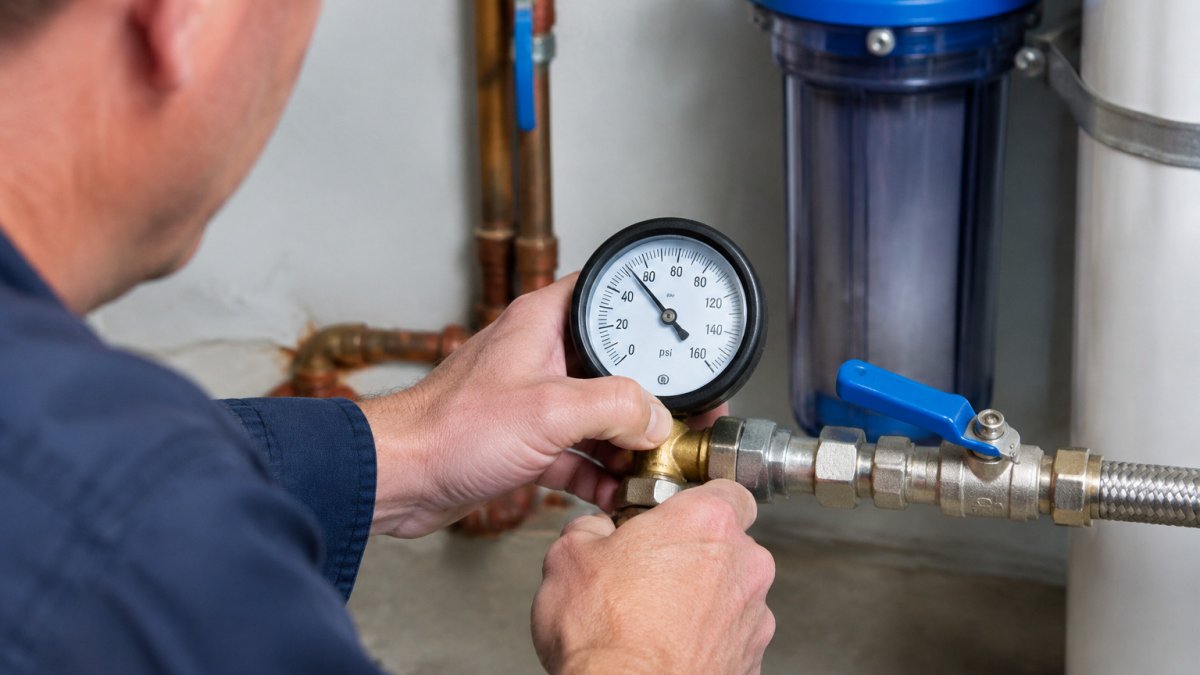
A water pressure test checks how hard water pushes through your home’s pipes, using a gauge that reads in PSI. Attach the gauge to an outdoor hose bib, turn off other water use, and open the faucet fully. Normal household pressure is usually between 40 and 80 PSI.
- Attach the gauge to an outdoor hose bib and hand-tighten it.
- Turn off the dishwasher, washing machine, and other water use first.
- Readings under 40 PSI call for a check with your water supplier.
- A free home water test usually checks quality, not pressure.
Table of Contents
- What a Home Water Pressure Test Tells You
- How to Test Home Water Pressure in 5 Steps
- Normal Household Water Pressure PSI and What Your Numbers Mean
- Is a Free Home Water Test the Same as a Pressure Test?
- Checking Your Water Pressure Regulator
- Book Your Free Water Test With Kevin’s Soft Water
- Frequently Asked Questions
Knowing your home’s water pressure helps you spot problems before they turn expensive. This guide shows you how to check your pressure at home with a simple gauge. A free home water test is different from a pressure test, and we explain the gap below. Water pressure is measured in PSI, or pounds per square inch.
What a Home Water Pressure Test Tells You
A water pressure test shows how hard water pushes through your pipes. It uses a gauge that reads in PSI. Low pressure can mean a clogged line, a failing regulator, or a problem with your water supplier. High pressure can wear out faucets, water heaters, and appliance hoses over time.
Here is what a basic pressure check can tell you:
- Whether your pressure is in a normal range
- Whether pressure drops when several fixtures run at once
- Whether one area of the house has weaker flow than others
A pressure test does not check what is in your water. For that, you need a water-quality test. If you wonder whether hard water affects your skin, read how hard water can affect your skin.
How to Test Home Water Pressure in 5 Steps
Plan on about 15 minutes. You do not need any plumbing skills for this test. Follow these steps in order.
-
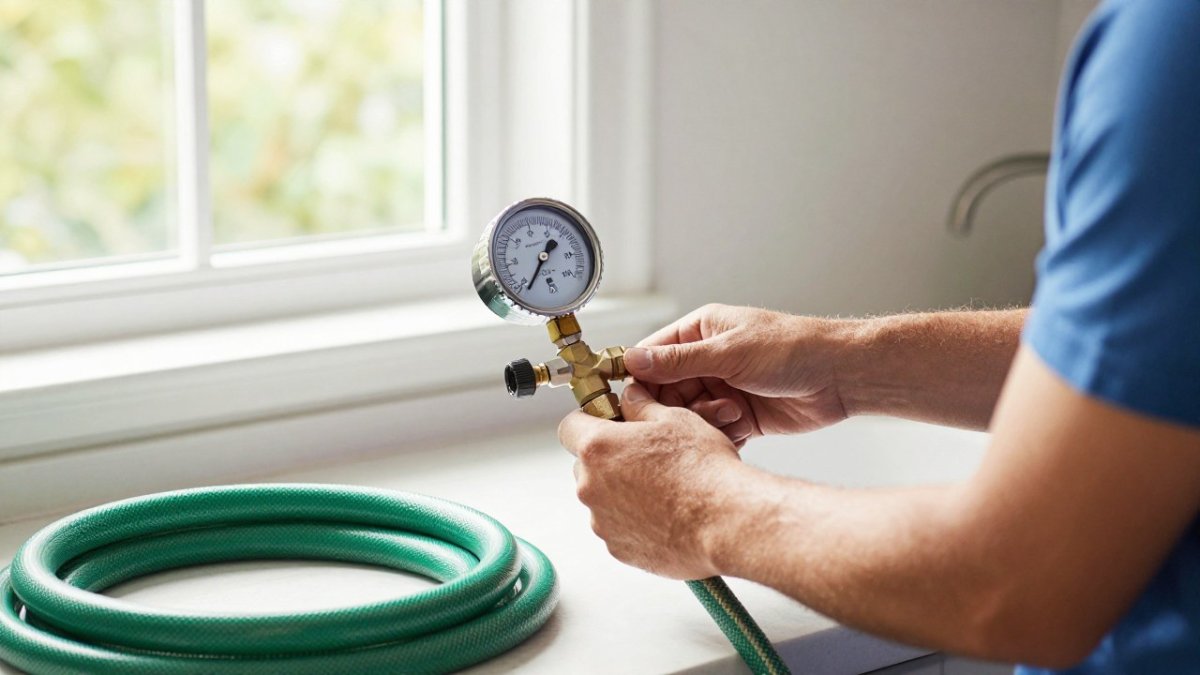
Get your gauge ready. Buy a water pressure gauge that has a hose thread on one end. Most gauges fit a standard garden hose connection, which is about 3/4 inch. Screw the gauge onto an outdoor hose bib, the outside faucet where you normally hook up a garden hose. Hand-tighten it, then check that it is snug.
-
Turn off other water use. Shut off the dishwasher, washing machine, and any showers or sinks in use. Ask anyone in the house to stop running water. Water use inside the house can lower your reading and make it look like a problem when there is none.
-
Open the faucet fully. Turn the outdoor faucet handle all the way on. This first reading is your static pressure, which is the pressure when no water is moving. Wait a few seconds for the needle to settle.
-
Read the dial. Note the number where the needle stops. Write it down with the date and time.
-
Check a second spot while water runs. Turn on an indoor faucet, such as a kitchen sink, and watch the gauge while it runs. The reading that drops while water flows is your dynamic pressure. Write down both numbers.
-
Repeat in other spots. Test a second outdoor faucet or an indoor sink on the other side of the house. If both places read low, the problem is likely with the whole system. If only one place reads low, the problem is probably in the pipes near that fixture.
What You Need Before You Start
Gather these items first:
- A water pressure gauge with a hose thread connection
- A standard garden hose or outdoor hose bib
- A notepad or phone to record readings
- A helper, if you want to run fixtures while you watch the gauge
Most gauges connect to a standard 3/4-inch hose thread. Check the package before you buy.
Watch out: do not force the gauge onto a faucet that is leaking or has a damaged thread. Tighten it by hand and stop if it feels stuck.
Reading the Gauge
Look at the needle and note where it settles. Take the reading when it stops moving, not while it is still climbing. Some gauges have two needles or a small marker. The main needle shows the current pressure.
If the needle does not move at all, check that the faucet is fully open and that the gauge is tight. If the needle jumps around, the water supply may be unstable, so run the test again later.
Write down the number. Compare it with the normal range in the next section. If the number looks off, run the test again in a different spot to confirm.
Normal Household Water Pressure PSI and What Your Numbers Mean
Many homes have pressure between 40 and 80 PSI, which stands for pounds per square inch. The Spruce’s guidance flags readings below 40 PSI for follow-up with your water supplier, so that is a good number to watch for. The Spruce guide on checking home water pressure with a gauge
Here is a simple way to read your results:
- Under 40 PSI: Pressure is low. First, check whether other homes on your street have the same problem. If they do, call your water supplier. If only your home is affected, check for a partly closed main shutoff valve, a clogged filter or screen on a faucet, or a problem with the pressure regulator.
- 40 to 80 PSI: This is usually a healthy range for most homes.
- Over 80 PSI: High pressure can strain pipes, water heaters, and appliance hoses over time. A pressure-reducing valve may help. Ask a licensed plumber to check the setting before making any change.
A reading taken during heavy water use can look lower than your normal pressure. That is why you should test with the house quiet and compare your static reading with your dynamic reading. A large drop when one faucet runs can point to a restriction in the line serving that fixture.
Before you call a plumber or water supplier, run through these checks:
- Test at two or more outdoor and indoor spots.
- Confirm the main shutoff valve is fully open.
- Clean the screens on faucets and showerheads.
- Repeat the test at a different time of day to see if the reading changes.
If the problem persists after these checks, write down your readings and the times you took them. This record will help a plumber or your water supplier find the cause faster.
Here is a quick guide to reading your results against the normal range.
| Reading | What it means | What to do |
|---|---|---|
| Under 40 PSI | Pressure is low | Check neighbors, then call your water supplier |
| 40 to 80 PSI | Usually a healthy range | No action needed |
| Over 80 PSI | Can strain pipes and appliances | Ask a licensed plumber to check the setting |
Is a Free Home Water Test the Same as a Pressure Test?
No. A free home water test usually checks water quality, not pressure. Culligan describes a free in-home test for water-quality problems, and it does not say that pressure is tested. Culligan free in-home water test information
A pressure-gauge test and a water-quality test answer different questions. Low-cost tests may also miss things that a certified lab would catch. Tap Score’s guide explains what cheap and free tests really measure and what they miss. Tap Score guide on cheap and free water tests
If you want to know about both pressure and quality, ask any provider which tests they run.
Kevin’s Soft Water offers free in-home or in-store testing, and we use results to recommend options. Our solutions for the water you actually have cover iron removal, sulfur odor treatment, and filtration in Central Indiana.
Checking Your Water Pressure Regulator
A pressure-reducing valve, often called a regulator, controls how much pressure enters your home. It usually sits near where the main water line comes in.
If your readings are consistently high, the regulator may be set too high or failing. If readings are low across the whole house, the regulator may be the cause. Check the regulator setting and compare it with your gauge readings. If you are not sure how to adjust it, ask a licensed plumber.
Watch out: do not adjust a regulator without knowing its current setting, or you may make pressure worse.
Book Your Free Water Test With Kevin’s Soft Water
A pressure reading is useful, but it tells only part of the story. A free water test from Kevin’s Soft Water checks what is actually in your water, so we can recommend the right equipment. Know your water with a free test at your home or at our store.
Have questions before you book? Have a water question? We’re close by.
Still curious about your water? Let’s get it tested. Call Kevin’s Soft Water to schedule your free test and get treatment recommendations built around your home.
Frequently Asked Questions
How can I test the water pressure in my house?
The simplest way is with a water pressure gauge, which is sold at most hardware stores. Screw the gauge onto an outdoor hose bib or a utility sink faucet, turn the water fully on, and read the dial. Make sure no other water is running in the house during the test, since that can lower the reading. Write down the number, then repeat the test at a second spot, like an upstairs bathroom, to see if the pressure holds up through the home.
What PSI should my water pressure be in my house?
Most homes in the United States have water pressure between 40 and 80 PSI. Readings below 40 PSI can mean weak flow in showers and slow-filling appliances, and readings above 80 PSI can strain pipes, fixtures, and water heaters. If your reading falls outside this range, contact your water supplier or a licensed plumber to find the cause before making any repairs.
Is a free in-home water test the same as a water pressure test?
No. A free in-home water test usually checks water quality, such as hardness, iron, or sulfur, while a water pressure test measures how strongly water moves through your pipes. Some providers offer both, but you should ask which one is included before you book. Kevin’s Soft Water offers a free water test that looks at your water quality so we can recommend the right equipment for your home.
